2026
Wuthering Heights
The paper 'The Constructed Center: Gender, Gaze, and Marginalization in Wuthering Heights' asks one question: is the 'center' that places Heathcliff's revenge at the heart of the novel really a natural formation? Using the notion of the 'male gaze' from gender criticism, I trace how it constructs a viewing position afraid of being looked back at, how it demonizes the women who look back, and how it is reinforced by the marriage property law (coverture). Around the same theme I also made three pages of adapted comic.
CourseELA 2.5
TheoryMale gaze · gender criticism
Consists ofPaper / comic
Textual analysisComic
Pages
3 pages · scroll sideways, or click to enlarge and page through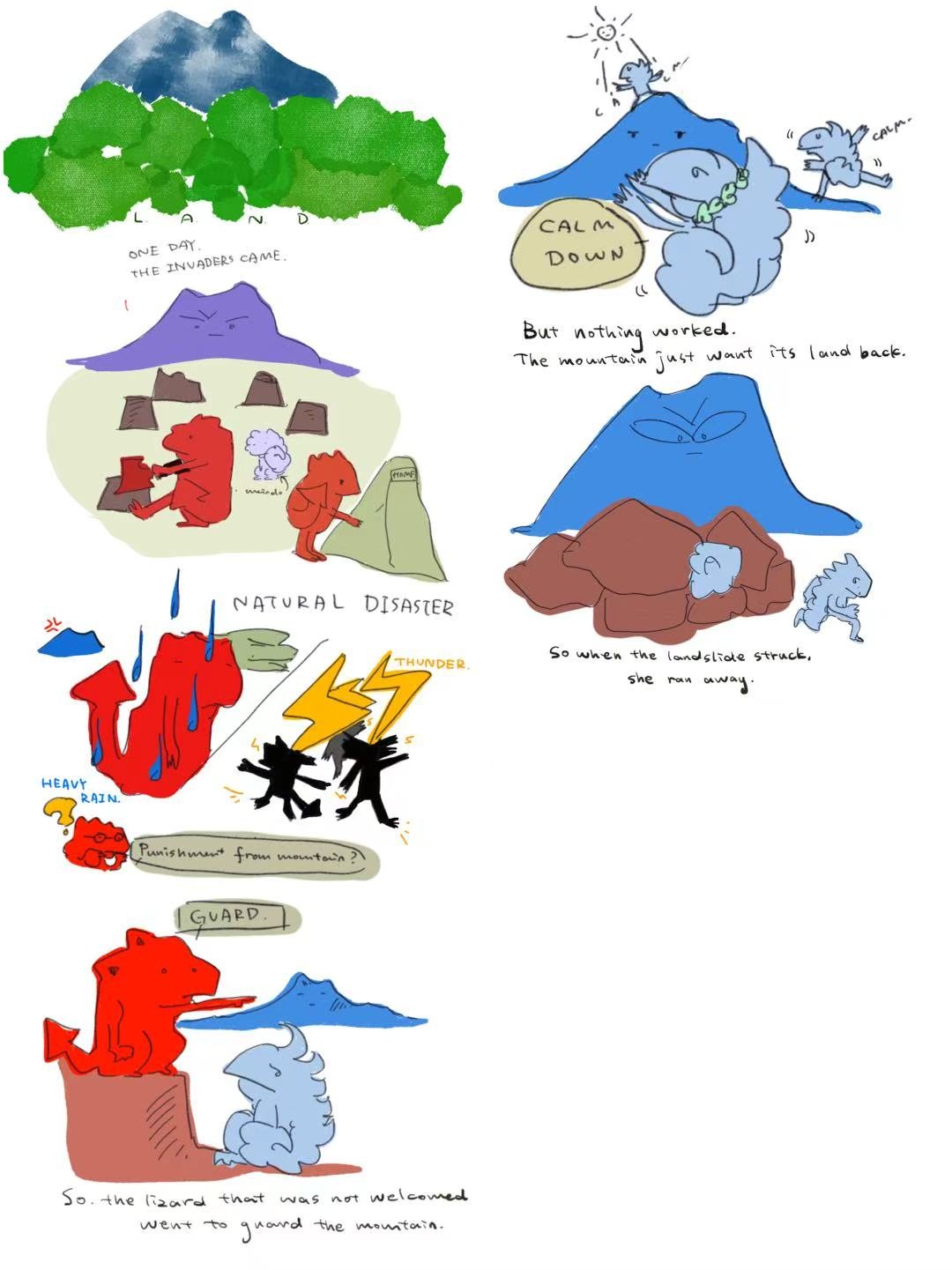
01 · Page 1 · Opening
02 · Page 2 · Schema of the gaze
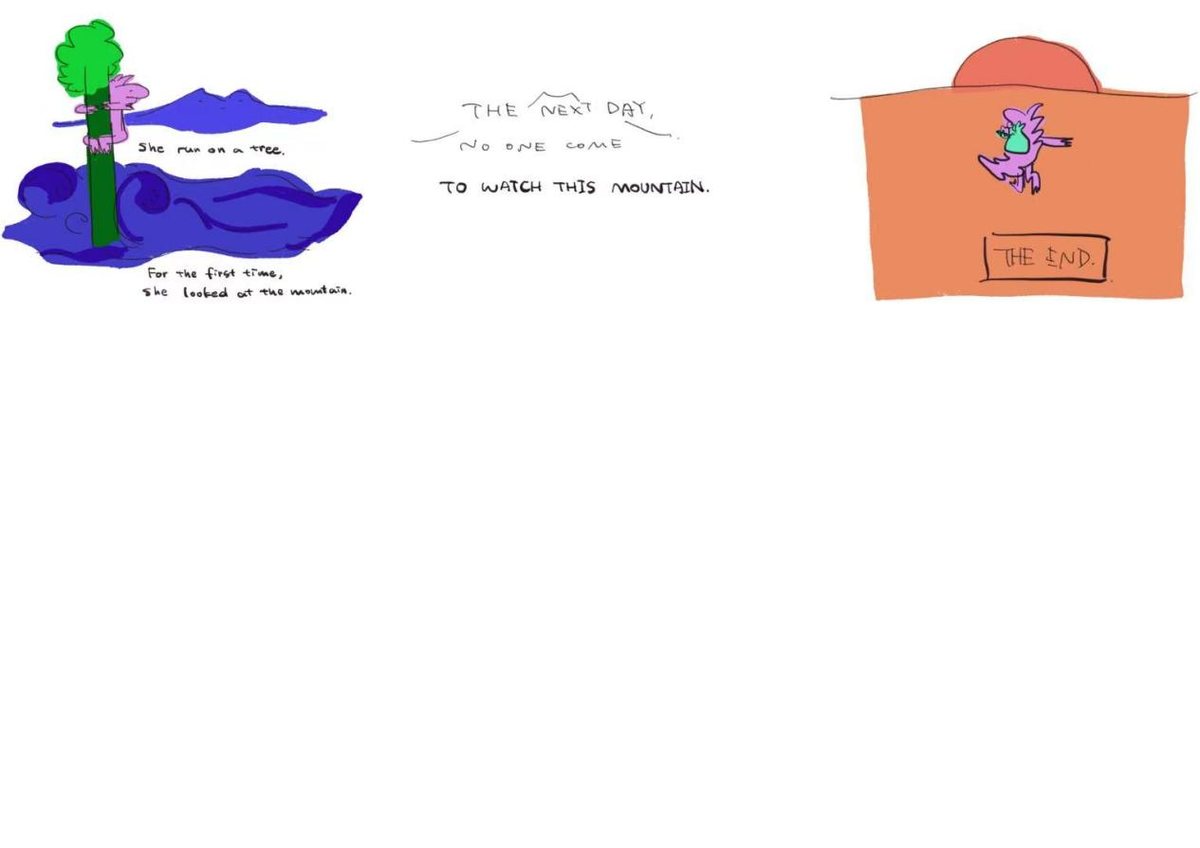
03 · Page 3 · Closing
The Work
Full TextChenqiushi
James Otyehel
Ela2.5
2026.6.3
The Constructed Center: Gender, Gaze, and Marginalization in Wuthering Heights
Critics have long considered Heathcliff’s revenge the center of Wuthering Heights. But is this center formed naturally? As Stoneman claims, many critics in the past “had too often assumed that Heathcliff was the centre of the novel” (Stoneman 148). So I raise questions about how revenge is constructed as the center, and how this centralization blocks female characters and female narrative voices? In this text, I will use the concept “male gaze” in gender criticism to analyze these questions. Specifically, I will examine how the male gaze constructs a spectator position that fears being looked back at, how it demonizes women who return the gaze, and how it is reinforced by the legal structure of coverture.
First of all, Lockwood's narrative position is a structure of a male gaze, which is a power structure where men watch and women are watched. Lockwood is afraid of being "looked back at" by women, so he seeks a safer way to gaze. Lockwood’s sense of security depends on occupying the ‘spectator’ position. Being ‘looked back’ at would reduce him to an object of judgment, which triggers his anxiety. Lockwood’s response to a woman’s look is described as he retreated “colder and farther”, as if a woman’s look could physically push him away (Brontë 6) . According to Newman, to narrate is to gaze, so listening to Catherine’s story is a safe way for him to gaze Catherine. By doing so, he can consume her as the subject of his narrative without being looked back at. Critics are just like Lockwood. They choose to safely gaze Heathcliff without facing the threat that comes from women looking back, because Heathcliff’s suffering invites observation without challenging this order. Therefore, this preference for male gaze is not neutral. It actively constructs Heathcliff as the center, while marginalizing those female characters who refuse to be looked at.
Catherine Linton, who dares to "look back", has been demonized by almost all male characters—that is, labelled as a witch, monster, or sexual deviant so that she can no longer be safely gazed upon. According to gender criticism, when a woman looks back, it means she declares that she is a subject not an object (Newman 1032). This threat to the power structure must be suppressed by the male characters. In the story, Joseph replies “It’s yon flaysome, graceless quean...wi’ her bold een” to Catherine’s lookback (qtd. in Newman 1032). The word ‘quean’, carrying meanings of a sexually forward woman—explicitly links Catherine’s ‘bold een’ (eyes) to moral corruption. Bronte's use of dialect tries to make this moral judgment seem like a community consensus. The purpose of this judgment is precisely to deny the subjectivity that Catherine declared through "looking back". This is precisely what Joseph wants to suppress. Thus, Catherine is structurally excluded from the position of a ‘safe’ object of gaze.
Although Isabella's story has long been marginalized by critics, Bronte uses typesetting and spatial arrangement to imply that her narrative deserves attention. Critics have long focused on Catherine and Heathcliff’s romantic story, because revenge and entangled emotions better fit the tragedy structure. The story of how Isabella was deceived, abused and eventually escaped cannot be incorporated into the framework of this romantic tragedy, so it is ignored as "filler". In the book, Isabella’s name appears boldly on the page at the end of the letter, “for her name is even more dramatically set off spatially and typographically” (Pike 355). Brontë uses typographical emphasis to signal that Isabella’s story matters, confronting the narrative’s own tendency to marginalize her. In this case, it is a good example of a constructed centrality: it is not that her story is unimportant, but that the critics chose not to read it.
Isabella 's experience reveals the structural violence in Wuthering Heights. Heathcliff’s abuse of her is not personal madness, but systemic power permitted by the coverture legal system. In 19th century’s coverture system, married women do not have an independent identity and their husbands have rights to “protect” them. In the text, Heathcliff said “and I, being your legal protector, must retain you in my custody, however distasteful the obligation may be” (Brontë 160). Yet Isabella is not always the passive victim. She writes letters to record her encounter and in the end she successfully escaped. By doing so, she reclaims her voice that coverture sought to erase.”
People might argue that critics focus on Heathcliff simply because his revenge drives the plot. But this objection misses the point: the question is why revenge was ever allowed to become ‘the plot’ in the first place, rather than Isabella’s escape or Catherine’s revolt. Through my analysis, the very definition of what counts as ‘central’ is a gendered construct. My analysis reveals three ways that the center is constructed. These are the male spectator position, the demonization of returning female gazes, and the legal system of coverture. Through Isabella, we see that the revenge center is not natural but chosen and constructed.
Works cited
Brontë, Emily. Wuthering Heights. Collins Classics, 2010.
Newman, Beth. “The Situation of the Looker-On”: Gender, Narration, and Gaze in Wuthering Heights. vol. 105, no. 5, 1990, pp. 1029–1041. Modern Language Association, 1990. www.jstor.org/stable/462732
Pike, Judith E. “My name was Isabella Linton”: Coverture, Domestic Violence, and Mrs. Heathcliff’s Narrative in Wuthering Heights. vol. 64, no. 3, 2009, pp. 347–383.University of California Press, 2009. www.jstor.org/stable/10.1525/ncl.2009.64.3.347
Stoneman, Patsy. “Feminist criticism of Wuthering Heights.” vol. 4, no. 2, 1992, pp. 147–153. Berghahn Books, 1992 JSTOR, www.jstor.org/stable/41555645